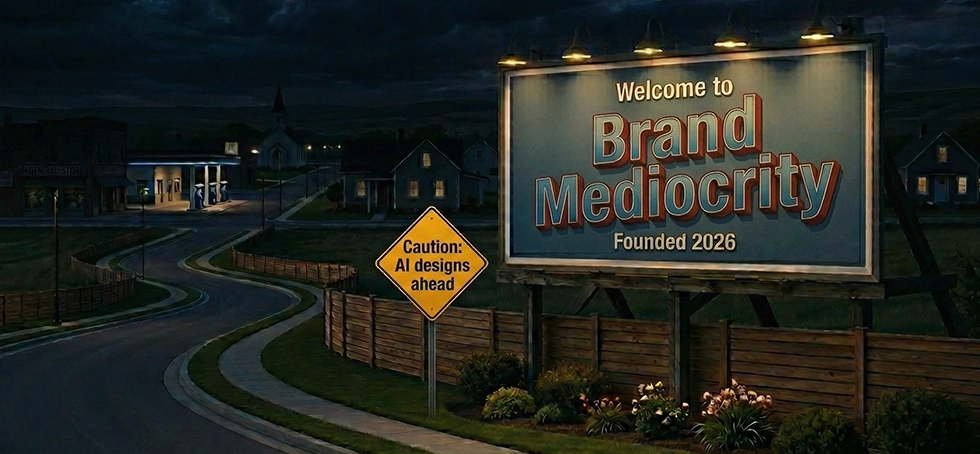
Your brand is the first signal your audience receives—It greets them before they experience your product, before they talk to your team, before they build trust. It’s the front door. And increasingly, that front door is coming off a little… well...unhinged.
Years ago, when I was just starting my creative career, I remember driving past an auto body shop. Parked outside was their company truck—beat up, worn down, faded paint, clearly not maintained. Their logo was slapped on the side. That truck was their billboard. A rusty, disintegrating billboard. And whether they intended it or not, it sent a message. If that’s how they present themselves, what does that say about the work they do?
It's a mental image that lingers as we enter an era of machine-enabled, on-demand design. Anyone can produce a logo, a color palette, even a full visual system in minutes with the help of AI. For many businesses, that’s more than enough to get started. But “good enough” is quietly becoming the standard—and that’s where the problem begins.
As we shift toward speed and convenience, we're starting to lose intentionality.
The typography choices and spacing. The color relationships. The tone of voice. The way visuals scale across different platforms. The entire system behind the surface. A logo might be the most recognizable element of a brand, but without strategy and intention, it’s just a meaningless mark.
When someone enters a prompt into a generative LLM hoping to come up with a cool logo, they're not always thinking about how it works within an entire ecosystem. They're probably not thinking how a condensed typeface can create tension or authority or how wider letterforms can feel more open and approachable. They don't understand how subtle adjustments in kerning can elevate something from standard to premium. These may be small details, but they compound. They shape perception in ways most people won’t consciously notice—but they’ll feel it.
That rigorously perceptive attention to detail is the difference between a brand that blends in and one that stands apart. And right now, a lot of brands are starting to blend in.
That doesn’t mean AI is the enemy. It’s a tool—an
incredibly powerful one. But like any tool, its output is only as strong as the thinking behind it. Without a clear point of view, without an understanding of brand systems, without a level of craft, what you get is fast… but forgettable.
The risk isn’t bad design. It’s mediocre design, which is arguably so much worse.
There are still designers who are standing strong against the trend, obsessing over the details, and holistically considering the full system. People like Allan Peters and James Barnard remind us what’s possible when craft, intention, and discipline come together. They're holding down the fort of tradition, labor, experience, iteration, and care.
When the dust settles, the brands that will be remembered aren’t the ones that were churned out the fastest. They’re the ones who understand that design isn’t decoration—it’s communication. It’s differentiation. It’s trust, built visually before a single word is spoken.
In the age of AI, intentional brand design may end up mattering more than ever. Because, without the deep thought that goes behind a brand system, many marketers are unintentionally parking rusty, dusty, broken-down billboards out front.
The question isn't whether more of this meritless mediocrity will ascend and spread. It's: who’s willing to push past it?